Other old car photographs


1936  Airflow  C-9

Serial Number 6607339

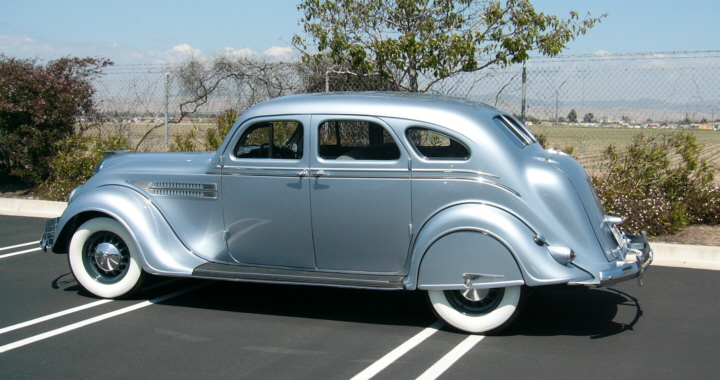
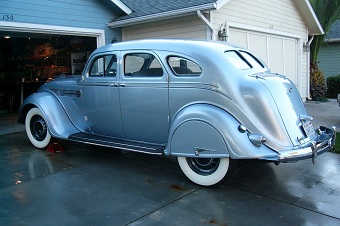
My Art Deco Chrysler is a Model C9, with the original 323 straight 8 cylinder engine.

It  rolled off the assembly line March 5, 1936.  

Airflows were produced from 1934 to 1937, and among other firsts, it was the first car designed using a wind tunnel.  C9s were only produced in 1936 and only 1,450 were produced.  Of these, 94 were 2 door coupes and 1,356 were four door sedans. So mine is one of 1,356 produced.  

It appears only 29 are still known to exist.


The Airflow design exhibited 40% less aerodynamic drag than other production cars of 1934, with a drag coefficient of 0.5.  In years to come, other cars had better aerodynamics, but Airflow was the first.  Here's how a few others cars have measured up.

1934 Tatra T77 design  cD = 0.22 1936 Lincoln Zephyr  cD = 0.45 1946 VW Beetle  cD = 0.49 1948 Tucker Torpedo  cD = 0.39
1949 Nash Airflyte  cD = 0.43 1949 Saab 92  cD = 0.35 1955 Citroen DS cD = 0.38 1959 Chevy Impala cD = 0.44


This C9 is a curious automobile, and its been interesting to piece together its history.  

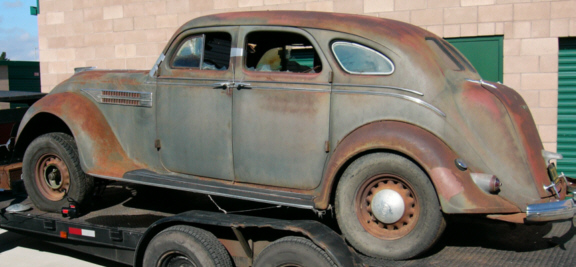
Mine was delivered to the Chrysler dealer in Sacramento, CA, and apparently purchased new at the Chrysler dealer in Esparto in 1936.  The purchaser was an almond and english walnut farmer, who drove the car daily until about 1951.  He parked it next to his barn with 66,900 miles on the odometer and there it remained.  For the entire 56 years since, the car didn't move.  The entire time I've been alive, this car was sitting in one place, covered in tarps, tires flat, engine stilled.

The car is entirely complete, but there was rust rust in the roof panel, the trunk floor and the back seat area.   There was one piece of external trim missing, otherwise everything that had been on that car  when produced in 1936 was still there. (I have since been able to locate a replacement trim, to the car is again 100% complete.)

The transmission and overdrive required nothing more than cleaning and gasket replacement.  Once the engine got disassembled, it became apparent the thermostat was rusted wide open and the head gasket had blown.  That's why it had been parked in 1951.  Now April 2007,  the engine rebuild is complete, and was started April 5 for the first time since 1951.  The engine was reinstalled May 2.

My original goal was to have a nice modernized Airflow daily driver, but once I realized how scarce these models are now, I changed gears in midstream and decided to do it up right and restore it best I can.   With the 8 cylinder engine, and smaller mass of any of the four door models, performance would easily compare with the two door coupes.  I did have a few things done to enhance performance (such as electronic ignition) while keeping the original configuration as much as practical.  After it's done, I plan to take it out on one of those dry lake beds  here in California and see if I can't beat that original 1934 land speed record that Airflows were famous for. 


  Progress Status. 


Airflow Arriving December 2005


When the auto builders glued insulation to the inside of the roof panel, they apparently wrote the date in glue. As the old material has come off, the date has remained.  Nov 23, 1936 - that's when the car was assembled.


The transmission stamping indicates it was produced November 15, 1935. 


Above: Battery box sees light of day after 55 years.

Upper right: Art Deco pattern on door panel


Spider Web tailight


Detailed weave pattern in interior upholstery.