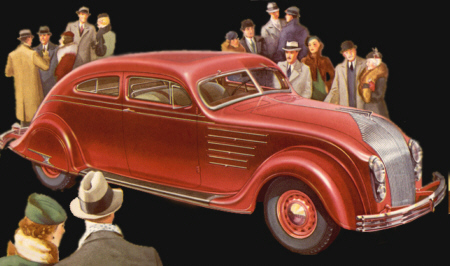
part of early Chrysler promotional artwork for a coupe.
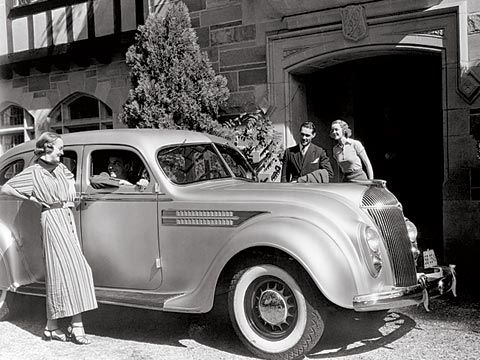
The Airflow came out in 1934, in both Chrysler and DeSoto models. Chryslers had the 8 cylinder engine, Desotos, the six.
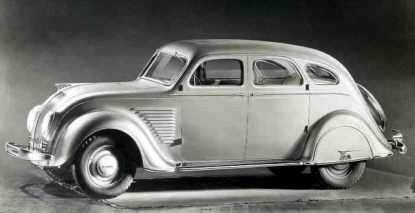
The 1934 Desoto Airflow sedan.
Airflow design
Airflows were important cars. Born at the start of the Art Deco 'Streamlined' movement in auto design, in many ways the Airflow started it all. The Airflow broke new ground, the first mass produced car developed with aerodynamic science behind it's design engineering. They were produced from 1934 to 1937. A technically advanced car, it's features still compare well with cars built over the next 30 years. |
|
part of early Chrysler promotional artwork for a coupe. |
The Airflow came out in 1934, in both Chrysler and DeSoto models. Chryslers had the 8 cylinder engine, Desotos, the six.
The 1934 Desoto Airflow sedan. |
The 1930s were a time of significant change in automotive design. To really understand the Airflow, it may not be enough to just look at its Design. To really 'get it', you have to compare it against the other cars on the road at the time.
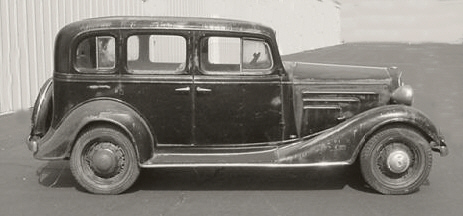
1934 Chevrolet back seat directly on axle |
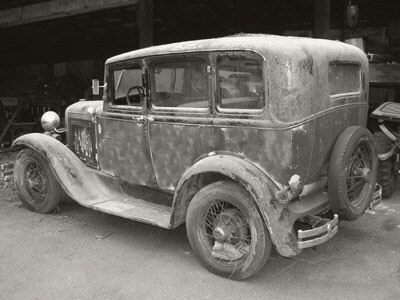
Early 1930s cars were designed on the 'carriage' construction design, a wooden body attached onto a separate steel chassis. Look at any car prior to 1934 and the 'carriage' design can still be seen, especially in the back of the car, the configuration of which no-one really ever paid any attention to aerodynamically. Cars simply didn't go fast enough for it to matter. |
1934 Ford Model A back seat directly on axle |
|
|
By 1934, mechanical design of automobiles,
drive train, suspension, handling, etc, were sufficient to attain respectable
speed and the flow of air around the car became more important.
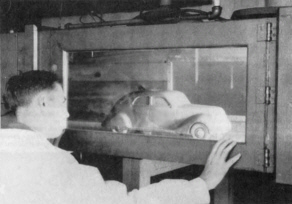
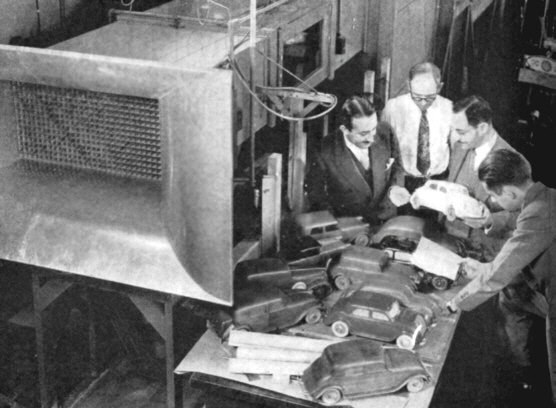
Airflows were the first cars to try and avoid the drag inherent in the previous 'carriage designs' when traveling at highway speeds. Its tapered aft end allowed the air to flow more fluidly around the car shape, whereas other cars were still 'pulling' a bit of a vacuum behind them (so to speak). This 'drag' drained away some of the mechanical energy being generated by the drivetrain. The intent of the Airflow design was to alleviate some of that loss. Wind tunnel research provided data on aspects of various design features which ended up in the Airflow. |
| The
Airflow design
exhibited 40% less aerodynamic drag than other production cars of
1934, with a drag coefficient of 0.5.
In years to come, other cars had better aerodynamics, but Airflow was the first. |
|
|
Here's a sampling of drag coefficients determined in later years for several other Streamline designed cars.
|
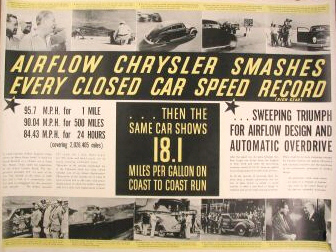
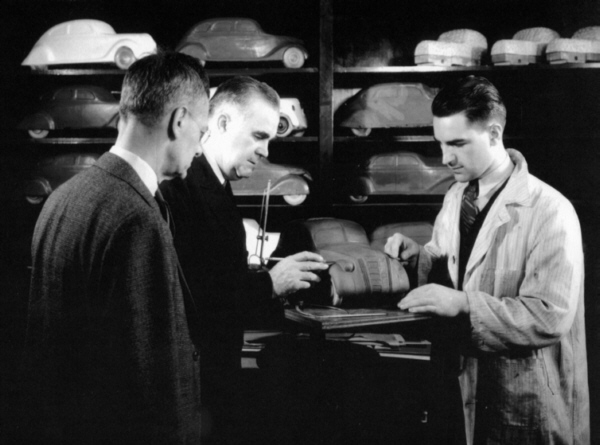
I received this image from Chrysler, when I got the Build Sheet for my C9.
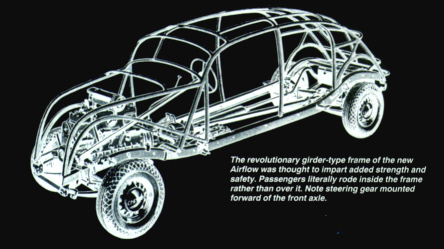 |
It's body is like a fuselage, aerodynamic, with subtle contours. The doors are compound curves, its lines fluid. The first attempt at 'unibody' construction, it's like a steel cocoon, designed for passenger safety. Window area is rather small compared to the sheet metal. All steel, except for the floor, which was wooden panels in a metal frame. |
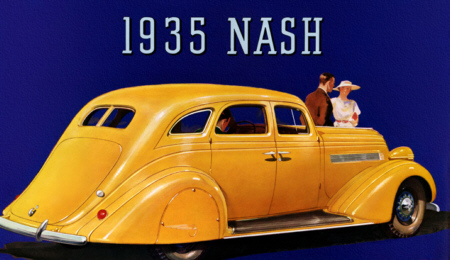 |
Streamlining first pioneered by the Airflow was widely adopted by other car manufacturers. Check out the ad for the 1935 Nash, a blatant attempt to ride on Airflow innovation. The Nash 440 was a direct derivative of the Airflow, but was still criticized as still being 'stodgy', as in not graceful enough, because its lines did not seem to have contours as 'flowing' as they could have been. Still, pretty cool automobile.
I'd like to find one of these - Deco design permeates it. |
|
||
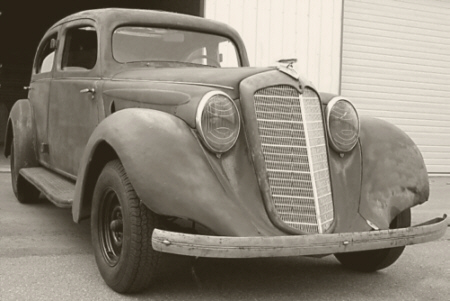
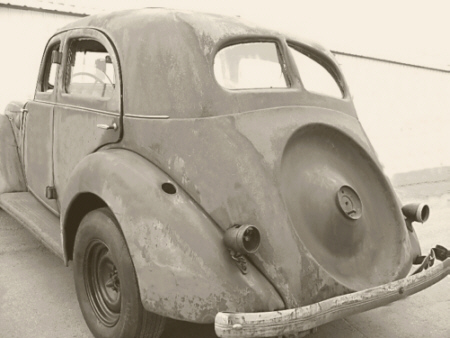
| Hupmobile produced an Aerosedan in 1935 which incorporated many design cues first seen in the Airflow, most noticeably perhaps the headlights integrated into the body, rather than atop 'bug-eye' posts. By 1935, the Streamlining trend was in full speed. (I would not mind having one of these Aerosedans either by the way) |
By 1936, car manufacturers had caught up to the Airflow in some ways, and even started to pass it in others. One case in point was all steel construction. Hudson Terraplanes were all steel, but the Airflow still had wood flooring. The advent of the single piece stamped steel roofs ("turret tops") was another development. Cars designed in '35 and produced in '36 could have a 'turret top' single piece roof. The Airflow, with its original fabric insert overhead when designed in '33, suddenly seemed to be not-so-advanced. But Chrysler recovered nicely, replacing the fabric insert with a steel insert panel starting in 1936, but took it one step even further. Isolating the insert panel electrically, they were able to use it as the antenna for the car radio, and avoid having to install external antennas. This clever use of what might be first described as a catch-up afterthought, put Chrysler back up to the vanguard of innovation.
|
|
The waterfall grille on the car when it was introduced was never well received by American buyers. So each model year Chrysler strived to improve upon it, even offering kits in later years to upgrade previous models to the most current look.
Each year's new grille design could change the way the hood opened. Many say the '36 grill (left) is the best, but the grille opens with the hood now, and adds significant weight. |
By 1940, cars had gone all metal, were sleeker (if heavier) but had more power and looked more like cars do now. There's a bigger change between 1934 and 1936 cars than between 1936 and 1939. 1936 may represent the most significant transition year.
More to come
Updated 13 April 2010